


You can share a home, a dog, a Costco membership, and more streaming passwords than you can remember. But sharing a life does not automatically give an unmarried partner the inheritance rights of a spouse.
Estate planning for unmarried couples in New Jersey means putting your choices in writing: who should inherit your property, who can handle your finances if you become incapacitated, and who should make healthcare decisions when you cannot.
A long relationship, an engagement, or a shared address does not replace those documents. The good news is that you can plan for the people you choose, whether marriage is on your calendar or nowhere in your plans.
Does New Jersey recognize common-law marriage?
Living together for seven years, ten years, or several decades does not create a common-law marriage in New Jersey. The state stopped allowing new common-law marriages to be formed within New Jersey on December 1, 1939.
A common-law marriage validly established elsewhere raises a different question. New Jersey may recognize a valid out-of-state marriage, subject to its laws and public policy. Moving here does not automatically erase a marriage. If that is your situation, have an attorney confirm your legal status before assuming the rules for unmarried partners apply.
Civil unions and legally recognized domestic partnerships also have specific rights. Calling someone your “domestic partner” in everyday conversation is not the same as having a legally recognized domestic partnership. This article focuses on couples who are not married and do not have another qualifying legal relationship.
Does an unmarried partner inherit if there is no will?
Not simply because you were a couple. When someone dies without a valid will, New Jersey’s intestacy laws determine who receives property that passes through the intestate estate. An unmarried partner does not receive a spouse’s intestate share merely because the relationship was committed or long-lasting.
Where there is no qualifying surviving spouse or partner, descendants generally come first, followed by parents and then other heirs in the statutory order. Your partner may receive assets through a valid beneficiary designation, survivorship ownership, a trust, or another enforceable arrangement. Those are separate questions from inheriting under the intestacy rules.
Marriage does not always mean a surviving spouse receives the entire intestate estate, either. Surviving parents and children from other relationships can affect the result. The New Jersey statute governing a surviving spouse’s share also includes exceptions involving certain divorce proceedings and agreements.
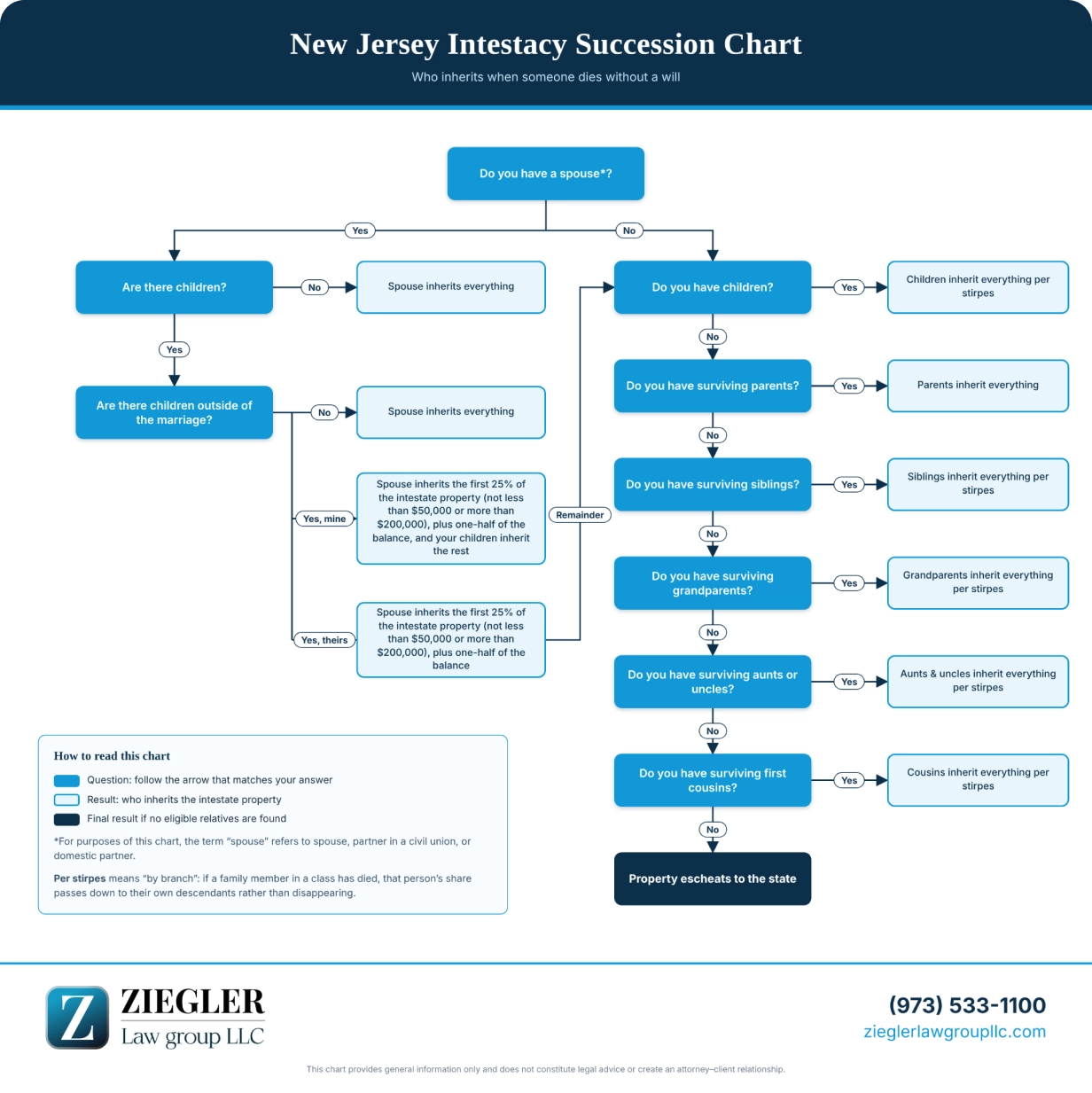
Who inherits under New Jersey law when property passes without a will. Property passing by beneficiary designation, survivorship or trust generally follows its own rules.
Start with the first question in the chart. The answer determines whether a spouse or qualifying partner gets a share before the estate passes to other family members.
Rather than relying on a family tree to produce the outcome you want, use a New Jersey will and estate plan to identify your beneficiaries and coordinate the documents that control your property.
What controls who receives your property?
Common ways property may pass at death
| PROPERTY OR ARRANGEMENT | WHAT TO REVIEW |
|---|---|
| Property in your name alone, with no beneficiary or survivorship arrangement | Your will generally directs probate property. Without a valid will, intestacy rules apply. |
| A home owned together | The deed matters. Tenancy in common and ownership with a valid right of survivorship can produce different outcomes. |
| Life insurance or an account with a beneficiary designation | The applicable designation and policy or plan rules generally control, subject to law, court orders, and enforceable agreements. |
| Property properly held in a trust | The trust terms and whether the property was actually transferred into the trust matter. |
This table is a planning guide, not a complete distribution chart. Debts, taxes, ownership disputes, family relationships, and other legal rights can affect what a beneficiary receives.
What happens to the home you own together?
Imagine that you and your partner each own half of your home as tenants in common. Your partner dies without a will and has no arrangement directing that ownership share to you. You generally keep your own share, but your partner’s share may pass to their statutory heirs. You could find yourself owning the property alongside members of your partner’s family.
That is different from a deed creating a valid right of survivorship. It is also different from a home titled only in one partner’s name. Paying the mortgage or household expenses does not, by itself, tell you who owns the property or who will inherit it.
Review the deed, mortgage, contributions, and your intentions together. A cohabitation agreement can address financial arrangements between partners, but it should be coordinated with your estate documents and property title. It does not automatically replace a will, beneficiary designation, or healthcare directive. Before changing a deed or adding an owner, discuss the tax, financing, and legal consequences with your advisers.
Which estate planning documents should unmarried couples consider?
A will and any appropriate trust
A will lets you name beneficiaries for property governed by the will and nominate an executor to administer your estate. Each partner should have documents reflecting their own wishes. If you have minor children, you can discuss guardian nominations and arrangements for managing an inheritance; a nomination does not override the rights of a surviving legal parent or the court’s authority.
A trust may help with particular goals, such as managing assets for children or setting conditions on distributions. Whether you need one depends on your property and family circumstances. Creating a trust without coordinating ownership and beneficiary forms can leave gaps in the plan.
Healthcare directives naming the person you trust
New Jersey recognizes two types of advance directive. A proxy directive names a healthcare representative to make decisions if you cannot. An instruction directive, often called a living will, records your treatment preferences. You may use either or both, as the New Jersey Department of Health explains.
If you want your partner to make those decisions, put that choice in the appropriate document. An emergency contact entry or a financial power of attorney is not a substitute. Discuss access to medical information, alternate representatives, and how your doctors and partner will obtain the documents when needed.
Our advance healthcare directive services address both the person you want to appoint and the wishes you want them to follow.
A durable financial power of attorney
A properly drafted durable financial power of attorney can authorize a trusted person to act on financial matters within the document’s scope and remain effective during incapacity. Discuss which powers are granted, when they take effect, and who should serve as a backup.
Sharing an address does not give your partner authority to manage accounts held solely in your name. This document also serves a different purpose from a will: a power of attorney generally ends at death, while estate administration then follows the applicable estate documents and law.
Current beneficiary designations
Check life insurance, retirement accounts, and accounts with payable-on-death or transfer-on-death instructions. A will generally does not override a valid beneficiary designation. Review both the primary beneficiary and any contingent beneficiary, and obtain confirmation that the institution accepted the form.
If either partner is still legally married to someone else, additional rules may apply. For example, some retirement plans provide spousal survivor protections and require consent to name another beneficiary. The U.S. Department of Labor’s retirement-plan guidance explains why plan terms and federal law matter.
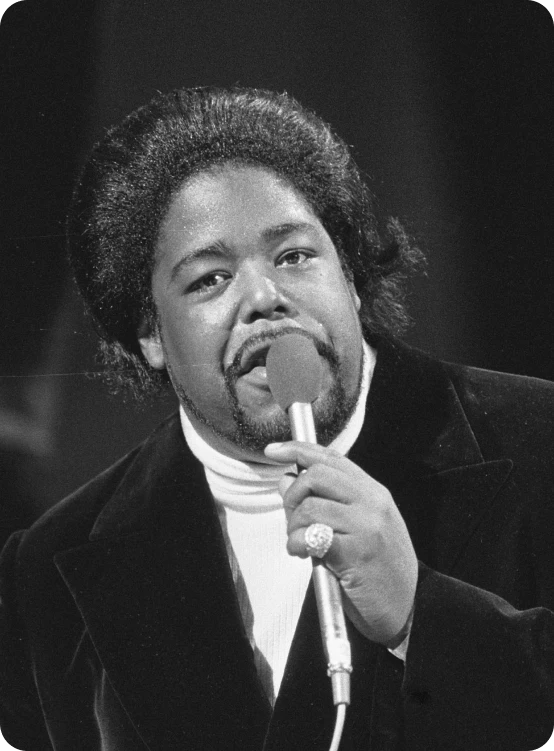
When soul singer Barry White died in 2003, he and his wife, Glodean, were living apart and still legally married. Years later, his son sued in California over payments he said he had been promised from his father’s trust. If you want your partner to receive your life insurance and your children to inherit through a trust, pull out both documents. Whose name is on the insurance form? What does the trust say each child will receive?
Do unmarried partners pay New Jersey inheritance tax?

They may. New Jersey inheritance tax depends on the beneficiary’s relationship to the deceased person and the property transferred. A partner who does not qualify for an exempt relationship generally falls into Class D. Karl Marx never envisioned this class struggle. Your sister generally falls into Class C, with the first $25,000 exempt from New Jersey inheritance tax. A partner you’ve lived with for thirty years can fall into the same Class D as Aunt Gladys, the one who still pinches your cheeks at family cookouts.
For taxable Class D transfers, the rate is 15% on the first $700,000 received and 16% on amounts above that. A Class D beneficiary receiving a total of less than $500 is exempt; this is not a $500 deduction from a larger taxable inheritance. The state publishes the inheritance tax rates and explains the small-transfer rule in its Inheritance Tax Return instructions.
Spouses, qualifying civil union partners, and qualifying domestic partners are among Class A beneficiaries, who are exempt. Ordinary cohabitation alone does not create that tax classification.
New Jersey no longer imposes its separate estate tax for deaths on or after January 1, 2018, but that does not eliminate inheritance tax. Federal estate tax is a separate consideration.
Ask how the rules apply to each asset and whether the estate will have funds to meet any tax obligation. A will, trust, or beneficiary designation does not automatically make a transfer tax-free. Tax planning should support your relationship and financial goals; it should not be reduced to “get married to save money.”
Review your plan when your relationship changes
Getting engaged, marrying, separating, divorcing, having a child, buying a home, and moving to another state are all reasons to review an estate plan. For example, would you want your spouse to be able to stay in the family home, with the home eventually passing to your children?
Before marriage, an attorney can help coordinate your estate documents with any prenuptial or postnuptial agreement, particularly when children from earlier relationships are involved.
If marriage isn’t in your plans

Goldie Hawn and Kurt Russell have spoken openly about building a family together without marrying. For a New Jersey couple making the same choice, two questions are worth asking. If one of you dies, who gets your share of the home? If you’re too ill to speak, who should make medical decisions for you? As Anthony Sytko puts it, “The fix is just paperwork.” Start with the deed and your healthcare directives.
After a breakup or divorce immediately above it

After a breakup, do not assume the relationship’s end updates your paperwork. Divorce can change certain inheritance rights and revoke some transfers under New Jersey law, but exceptions, federal law, plan rules, court orders, and agreements can change the result. Some pending divorce proceedings also affect a surviving spouse’s intestate rights before a final judgment.
Britney Spears once judged The X Factor. An ex’s name on a beneficiary form is one X factor you can check today. Ask for the designation on file, then have your attorney review any court order or settlement before you change it.
What to bring to an estate planning consultation
You do not need every answer before starting. Bring what you have, and make a note of anything you need to locate:
- Your current wills, trusts, powers of attorney, and healthcare directives.
- A list of assets and debts, including how each home or account is titled.
- Current beneficiary confirmations for retirement accounts and insurance policies.
- The names of the people you want to inherit and serve as decision-makers, plus backups.
- Information about children, prior marriages, civil unions, domestic partnerships, and relevant agreements or court orders.
- Your priorities for the shared home, ongoing expenses, dependents, and care during incapacity.
Tell your attorney where your wishes may differ from what relatives expect. That conversation can be uncomfortable; leaving everyone to guess later is usually harder.
Frequently asked questions
Can I leave my estate to my unmarried partner?
Generally, yes. A valid will, appropriate trust, and properly coordinated ownership and beneficiary arrangements can provide for a partner. Existing spousal rights, debts, taxes, and enforceable obligations may limit what is available to transfer.
Do we need estate planning if we do not own a home?
Yes, it is still worth considering. Healthcare decisions, access to finances during incapacity, and the beneficiaries of savings or insurance can matter even when you rent and have modest assets.
Is putting my partner in my will enough?
A will addresses only part of the plan. It does not appoint a healthcare representative, provide financial authority during your lifetime, or automatically change account beneficiaries or the ownership of a home.
Can a cohabitation agreement replace these documents?
It can address certain rights and obligations between partners, but it does not automatically perform all the functions of a will, healthcare directive, power of attorney, or beneficiary form. Have the documents reviewed together.
Plan for the people who matter to you
Your relationship status may be complicated. Your wishes deserve to be clear.
Ziegler Law Group LLC helps individuals and families in New Jersey prepare wills, powers of attorney, healthcare directives, and other estate planning documents. Anthony Sytko focuses his practice on estate planning and can help you identify the decisions and documents that fit your circumstances.
Request an estate planning consultation to discuss protecting your partner and the life you have built together.