
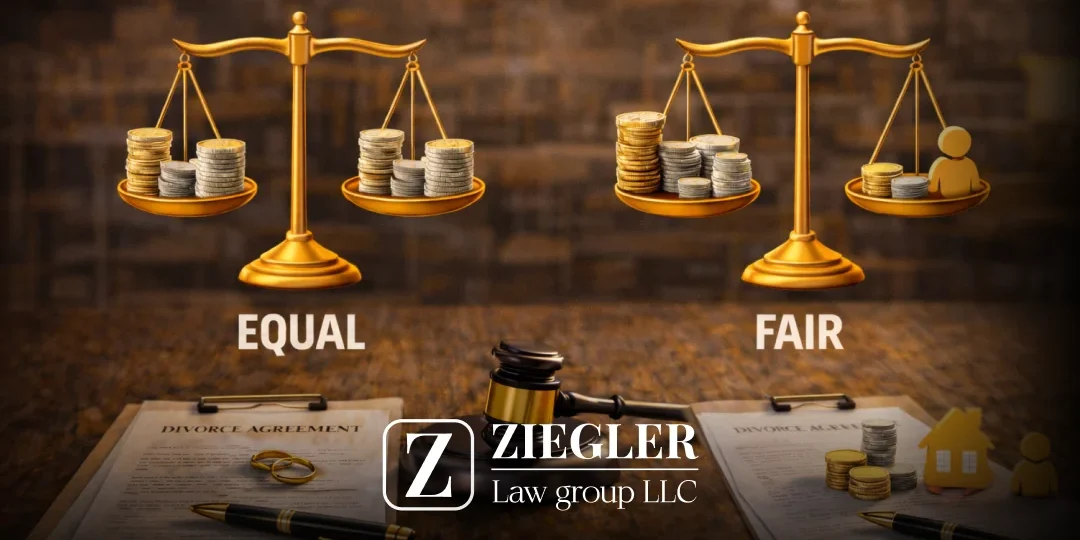
When people begin a divorce in New Jersey, one of the first fears is financial: Will everything be split 50/50? The answer is not as simple as many assume.
New Jersey follows the principle of equitable distribution, not automatic equal division. That distinction matters. Understanding how equitable distribution NJ courts apply the law can significantly affect how assets, debts, savings, and businesses are divided.
Fair does not always mean equal. And equal does not always mean fair.
What Is Equitable Distribution?
The Meaning of Equitable Distribution
Equitable distribution is the legal framework New Jersey courts use to divide marital property during divorce. The word “equitable” means fair under the circumstances, not automatically 50/50.
Under equitable distribution NJ law, courts evaluate multiple statutory factors to determine how property should be allocated between spouses.
This differs from community property states, where assets are generally divided equally.
Why Equitable Does Not Mean Equal
One spouse may receive more than half of certain assets depending on:
- Income disparity
- Contributions to the marriage
- Child custody responsibilities
- Future earning capacity
- Financial misconduct
This is why the common assumption addressed in New York 50/50 divorce state often creates confusion in New Jersey as well.
How New Jersey Applies Equitable Distribution
The court follows a three-step analysis:
- Identify which assets are marital property
- Determine their value
- Decide how to divide them fairly
Understanding what qualifies as marital property is critical. For a deeper breakdown, see marital property in New York, which explains classification principles that often mirror NJ analysis.
Equitable Distribution vs Equal Division in New Jersey Divorce
The Myth of Automatic 50/50 Splits
One of the most searched questions online is: Is my wife entitled to half my savings?
The answer depends on whether those savings are marital or separate property.
If the savings were earned during the marriage, they are typically subject to equitable distribution NJ rules. If they were acquired before marriage and kept separate, they may remain separate property.
Why NJ Is Not a Community Property State
New Jersey does not divide assets automatically down the middle. Instead, courts evaluate fairness based on statutory factors.
This distinction becomes especially important in high-asset cases such as high net worth divorce NJ, where equal division may not reflect economic reality.
When 50/50 Happens and When It Does Not
In many moderate-income marriages of similar earning spouses, courts may approximate equal division. But that is not required.
Long marriages with one primary earner often result in unequal but equitable allocations.
What Property Is Subject to Equitable Distribution in NJ?
Marital Property Definition
Marital property generally includes assets acquired during the marriage, regardless of whose name appears on the title.
Examples include:
- Real estate
- Bank accounts
- Retirement savings
- Business interests
- Investment portfolios
Separate Property Explained
Separate property typically includes:
- Assets owned before marriage
- Inheritances received individually
- Gifts given to one spouse
However, separate property can become marital if commingled. These risks are frequently misunderstood, similar to issues discussed in divorce myths.
What Money Cannot Be Touched in a Divorce?
Money that qualifies as separate property and has not been commingled may be excluded from equitable distribution NJ division.
However, appreciation during marriage may be partially divisible.
Commingling and Asset Conversion Risks
If premarital savings are deposited into joint accounts or used for marital expenses, they may lose separate classification.
This often becomes contentious in cases involving hidden assets in high-net-worth divorce , where tracing funds becomes necessary.
Factors Courts Consider in Equitable Distribution NJ Cases
New Jersey law requires courts to consider numerous statutory factors, including:
Length of the Marriage
Longer marriages typically involve deeper economic interdependence.
Income and Earning Capacity
Future earning potential plays a major role in asset division.
Contributions to the Marriage
Both financial and non-financial contributions matter. Homemaking and child-rearing are legally recognized contributions.
Standard of Living During Marriage
Courts aim to avoid drastic post-divorce financial imbalance.
Custodial Responsibilities
If one parent assumes primary custody, equitable distribution may reflect that reality.
Child-related financial planning often overlaps with tools such as the NJ child support calculator.
Tax Consequences
Certain asset divisions carry capital gains or tax penalties. Strategic structuring is critical.
How Equitable Distribution Works in High-Asset Divorces
In complex cases, equitable distribution NJ analysis expands significantly.
Business Ownership and Valuation
Business interests require valuation experts. These issues resemble concerns in family business audit.
Executive Compensation and Stock Options
Deferred bonuses and stock options require careful classification and timing analysis.
Real Estate Portfolios
Multiple properties complicate valuation and liquidity considerations. Housing disputes are often central, as seen in house division New York divorce.
Investment and Retirement Accounts
Retirement accounts may require Qualified Domestic Relations Orders (QDROs) for division.
Why Moving Out Can Impact Equitable Distribution Strategy
A frequent online concern is: Why is moving out the biggest mistake in a divorce?
Moving out prematurely may affect:
- Access to financial documents
- Control of household assets
- Negotiation leverage
Strategic planning before separation is essential, as outlined in divorce planning checklist New Jersey .
Common Mistakes in Equitable Distribution Cases
Hiding Assets
Attempting concealment can severely damage credibility.
Informal Agreements
Verbal arrangements without legal documentation create future disputes.
Ignoring Tax Consequences
An asset worth $500,000 may not be equal to $500,000 cash after tax exposure.
Equitable Distribution and Alimony: How They Interact
Property division and alimony are separate but interconnected.
Large asset awards may influence alimony determinations.
Understanding entitlement principles is similar to questions raised in divorced wife entitled to.
How Long Does Equitable Distribution Take in NJ?
The timeline depends on:
- Asset complexity
- Cooperation level
- Need for expert valuation
- Litigation vs settlement
For broader timing insight, review the New Jersey divorce process timeline.
Can Equitable Distribution Be Negotiated?
Yes. Many cases resolve through structured negotiation or mediation.
If considering alternatives to litigation, evaluating whether mediation is right for your divorce can be helpful.
However, full financial transparency is essential.
Ziegler Law Group LLC Contact
Equitable distribution is not about dividing assets mechanically. It is about protecting your financial stability for the future.
Whether your case involves retirement accounts, real estate, business ownership, or complex compensation, early strategy significantly influences outcome.
Schedule a confidential consultation with a family law attorney in New Jersey or New York today.
Call us at: 973-533-1100
New Jersey Office: 651 W. Mt Pleasant Ave, Suite 150, Livingston, NJ 07039
New York Offices: 3 Columbus Circle, 15th Floor, New York, NY 10019 | 107 North Main Street, New City, New York 10956
Frequently Asked Questions
What is equitable distribution in New Jersey?
Equitable distribution in NJ is the legal process courts use to divide marital property during divorce. It does not automatically mean a 50/50 split. Instead, the court divides assets fairly based on statutory factors such as income, length of marriage, contributions, and future earning capacity.
Is equitable distribution the same as equal division?
No. Equitable distribution NJ law focuses on fairness, not automatic equality. While some cases may result in a 50/50 split, courts are not required to divide property equally if fairness requires a different allocation.
What property is subject to equitable distribution in NJ?
Marital property acquired during the marriage is subject to equitable distribution. This can include real estate, bank accounts, retirement savings, business interests, and investments. Separate property, such as premarital assets or inheritances kept separate, is typically excluded.
Is my spouse entitled to half my savings in New Jersey?
Not automatically. If the savings were earned during the marriage, they are generally considered marital property and subject to equitable distribution NJ rules. However, division depends on fairness, not automatic equal division.
What money cannot be touched in a New Jersey divorce?
Separate property that was owned before marriage, inherited individually, or gifted specifically to one spouse may not be subject to equitable distribution — unless it was commingled with marital funds.
How long does equitable distribution take in NJ?
The timeline depends on asset complexity, cooperation between spouses, and whether the case settles or proceeds to trial. Complex equitable distribution NJ cases involving business valuation or hidden assets typically take longer than straightforward property division cases.
Can equitable distribution be negotiated outside of court?
Yes. Many equitable distribution NJ cases are resolved through negotiation or mediation. However, full financial disclosure is essential to ensure a fair settlement agreement.